
Schumer and Menendez said the months-long demonstrations have been met with orders from the central government and local authorities to shut off internet access in protest areas, cut off water and electricity supplies for the tens of thousands living in protest camps, and impede the work of journalists reporting on the protests.
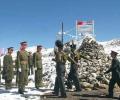
Suddenly the sands are shifting and even friends are acting strange.

The briefing comes ahead of the parliament session beginning Monday.

The Modi government has been put on notice.'Will it buckle under such pressure? These are times when the moral fibre of the leadership makes all the difference, observes Ambassador M K Bhadrakumar.
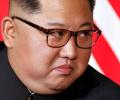
The visit, Kim's third since March, is taking place amid sharp escalation rhetoric between Beijing and Washington over tariffs almost spiralling into a trade war.

'Gotabaya will expect India to observe the red line.' 'He even dispensed with any gesture welcoming India as an interlocutor on the Tamil issue.' points out Ambassador M K Bhadrakumar.

China on Monday said differences remain among members of the Nuclear Suppliers Group over the inclusion of new countries and the issue was not even on the agenda of the grouping's meeting in Seoul this week, a day after External Affairs Minister Sushma Swaraj asserted that Beijing was not opposing India's entry
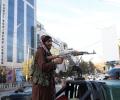
Delhi has come to accept the Taliban takeover in Kabul as a reality and seems increasingly unsure of its dogmatic view of the Taliban as a mere proxy of the Pakistani military and security establishment, observes Ambassador M K Bhadrakumar.
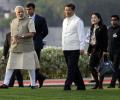
No Indian government has taken on China like this ever before and shows that the three top Indian officials -- Sushma Swaraj, Manohar Parrikar and Ajit Doval - ran into China's Great Wall on the twin questions of Pakistan and terror when they interacted with their Chinese interlocutors In past few days, says Rajeev Sharma.

The Western powers appear to regard Delhi as the most logical destination in the region in these extraordinary times -- as a counterpoint to the ascendance of political Islam and a rising red star over Afghanistan, observes Ambassador M K Bhadrakumar.

'We were scared about what would happen if these terrorists managed to enter the building.'
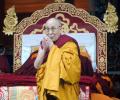
The papers said India is using the Dalai Lama as a "diplomatic tool" against China for its "vice like veto" against India's membership in the Nuclear Suppliers Group and United Nations ban on Jaish-e-Mohammed chief Masood Azhar.

The meeting with Xi is being held amid the ongoing trade war between the United States and China.

India remains North Korea's 2nd-largest import source after China, according to several estimates by multilateral bodies, says Subhayan Chakraborty.

The 17th Gyalwang Karmapa Ogyen Trinley Dorje last week visited Arunachal Pradesh, which China claims as a part of southern Tibet.

Under the policy, the US recognises and has formal ties with China rather than the island of Taiwan, which China sees as a breakaway province to be reunified with the mainland one day.

'The impasse on the India-China border in the Sikkim sector persists, but the Hamburg meeting between the two leaders will certainly have its salutary effects on the relationship between the two countries,' says China scholar Rup Narayan Das.

Chinese Foreign Ministry spokesperson Hua Chunying sounded firm about China's stance that all new members that join the NSG must sign the NPT.
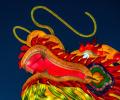
A new book reproduces original Chinese maps that contradict Chinese propaganda. The book reveals Chinese intelligence admissions that Beijing never maintained any army base, customs office or other government function in the disputed area until 1983.

China is opposed to India's oil exploration in the South China Sea because it is a disputed area, but regards its ambitious US $46 billion (Rs 2.9 lakh crore) economic corridor through Pakistan-occupied Kashmir a "livelihood project" with issues left over from history.

'Pakistan has robust incentive to turn heat on LoC.'

The new government needs to clearly insist on diplomatic reciprocal arrangements with China. While reciprocity is a function of power in bilateral relations, the Modi-led government's responses should be based on India'S inherent strengths, says China expert Srikanth Kondapalli.

'An authoritative source in the government tells me that India has emerged as the net security provider of the Maldives,' says Rajeev Sharma.

'His negotiations with Idi Amin and his men for compensation for the Indians, who left Uganda, were particularly tough. Apparently, Amin warned him that the body of the British negotiator, who came earlier, was found in a roadside gutter... As Jagat Mehta's special assistant during the last two years of his tenure as foreign secretary, I saw for myself how his conviction, courage and patriotism enabled him to fight against heavy odds, says Ambassador T P Sreenivasan.

We can learn much from China with regards to making civil service recruitment more efficient, says former diplomat Kishan S Rana.

The PM on Tuesday officially announced his visit to China from May 14 to 16.

Being a pragmatist Modi is not likely to give preference to China over Japan. Both security and economic aspects are likely to shape Modi's decision in terms of engaging the two biggest economies of Asia, says Sana Hashmi.
An adamant China on Thursday said "no country should or can put itself opposite the NPT".

Budget forces last minute change in finance minister's plans.

The flawed Indian policy toward Afghanistan is missing the woods for the trees. The Modi government doesn't have a 'big picture', observes Ambassador M K Bhadrakumar, who played a stellar role in beginning India's systemic dealings in Afghanistan in 1994.

Prime Minister Narendra Modi, whose selfie with Chinese Premier Li Keqiang grabbed eyeballs across the globe, on Sunday, extended his 'selfie diplomacy' to Mongolia by clicking one with President Tsakhiagiin Elbegdorj.

The G20 chair has suggested three areas for the talks in Argentina - the future of work, infrastructure for development and a sustainable food future, areas where India has a lot at stake.

China's growing concern over the existence of terror training camps in Pakistan, establishment of an energy corridor and firming up of nuclear energy cooperation will come up for discussion during Prime Minister Nawaz Sharif's talks with the Chinese leadership in Beijing.

The visit by Gen Rawat, Ajit Doval and Vijay Gokhale was the first such high-level trip from India to Bhutan after the Doklam standoff.
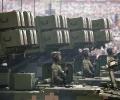
There is growing alarm at the inexorable rise of China, both of its military prowess and its aggressive bullying of other countries plus its subjugation of whole portions of its own population.

India has been eyeing deeper energy ties with Iran and has already lined up $20 billion as investment in oil and gas as well as in petrochemical and fertiliser sectors there.

Modi's arrival has changed the optics of the visit. There is a different demonstration of the confidence level in the Indian leadership, but not much has changed beyond that, reports Sheela Bhatt/Rediff.com.

Prime Minister Narendra Modi and Chinese President Xi Jinping on Thursday began summit-level talks.
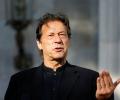
Khan's spokesman Dr Shehbaz Gill said that the prime minister has just a slight fever and cough.
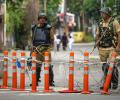
'None of these three countries -- Turkey, Iran or Malaysia -- ever made a hostile move against India to support the Pakistan-based terrorist elements,' notes Ambassador M K Bhadrakumar.
